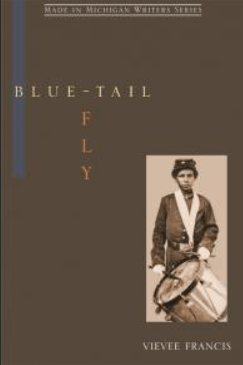
Vievee Francis’ entire body of work rejects the way nature is romanticized, reinventing what it means to be part “beast” as African Americans have been viewed throughout American history. As she states in an interview with Laura Steadwell for Muzzle, “African Americans…[have been] the only group in the United States legally considered part beast or chattel: I want to speak to that.” Francis manages to “speak to that” in a slow unraveling throughout her body of work, starting in Blue-Tail Fly. The first poem of the book, “The Scale of Empire,” explores small, dark parts of nature—the way it slowly grows over, feeds on the rotten, how the insects seem to have mastered it. In her second collection, Horse in the Dark, Francis’s poem “De Rerum Natura,” refutes the notion that two beings cannot be one—like a centaur—alluding to Titus Lucretius Carus’s De Rerum Natura as well as Ovid’s Metamorphoses. In the most recent collection, Forest Primeval, Francis explores, again, the de-romanticizing of nature, but at this point mixes her own identity with it. Beginning with the poem “Another Antipastoral” and ending with “Chimera,” Francis opens to accept her “beast,” hoping “to open yours” so it might be accepted as well.
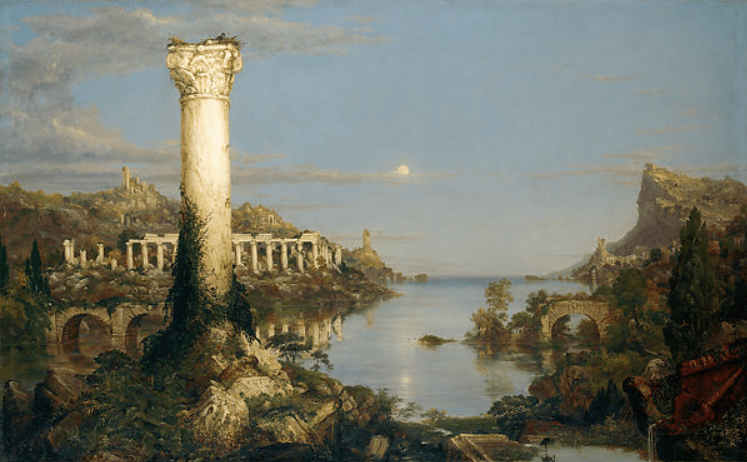
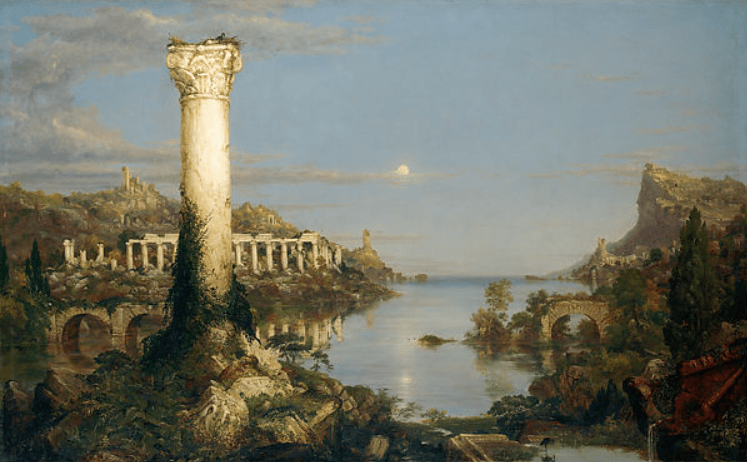
Before delving into Francis’ “The Scale of Empire,” it is important to know more about the painter Thomas Cole who inspired the piece. Thomas Cole, founder of the Hudson River School, was known for his romanticized paintings of the American wilderness, and in this poem Francis directly alludes to his series of five paintings titled The Course of Empire. Each painting depicts the same valley, as can be seen by a distinctive protruding rock in the background, and the slow desolation of the human “empire.” The first painting, The Savage State, portrays the wild beginning with native peoples hunting and gathering food in an overgrown forest. The second, The Arcadian or Pastoral State, showcases a more organized, pastoral nature with sheep, plowed fields, and a small hut. In The Consummation of Empire the whole scene is nearly rid of trees and replaced with white, Grecian temples and crowds of people. The fourth painting, Destruction, darkens, and war litters the streets. By the fifth painting, Desolation, there are no people, and nature has begun to take back the land. Relics of the Grecian structures are still present, but vines entwine them, and birds have built nests atop pillars. Like an epic, Cole’s paintings have a certain hugeness about them: the dramatic shifts from each painting, the long periods of time spanning the series, the landscape depicting exaggerated mountains and dramatic skies. In many ways, Francis’ “The Scale of Empire” responds to this aspect of “epic-ness” in Cole’s work, showing not the huge way nature consumes, but the small, creeping way it is able to survive.
Francis’ poem begins: “The wood that engulfs / an empire of stone / cares only to maintain itself….” In this first stanza, the speaker personifies wood to show its motive: “only to maintain itself.” The wood does not consume the “empire of stone” for the sake of being strongest but does so to simply “maintain itself” and survive. The first line of the second stanza continues this sentence: “to green again the decadent….” The many meanings of “green” come to play here: the literal green of the woods’ leaves, the aspect of making the wood new or “green” again, and paired with the term “decadent”—alluding to royalty—green is also seen as a color of wealth. The second line continues: “progressions—discovery….” These nouns bring to mind exploration and the American landscape (think of Christopher Columbus, Lewis and Clark, the pioneers heading west; all are romanticized in their own ways as “progressive”). The third line finally end-stops the sentence, simultaneously turning the poem’s mood on its head: “desperation.” Here, the romanticism in the previous two lines is challenged. The wood does not discover new territory out of luxury, but out of “desperation.” The second stanza then leads into the third: “Our delusion: / digging into the earth / that submits only temporarily.” This harkens back to Cole’s paintings with their cycle of nature: how it cannot be controlled by humans. Throughout this section, the repetitious “d” in words such as “decadent,” “discovery,” “desperation,” “delusion,” and “digging” seem to mimic the titling of Cole’s last two paintings, Destruction and Desolation, the least romantic, most apocalyptic paintings of the series.
The last line of the third stanza begins the up-close venture into nature’s world. “Eventually, the vine creeps across / the well-swept patio, up the walls, / then through, under the iron rails.” Here the scale of nature and its small achievements is shown by the slowly consumed structures: the patio, walls, and iron rails. The vine traverses the “well-swept” patio, hinting at the futile role humans play in the attempt to keep nature at bay. Walls should keep the indoor world away from the outdoor, but the vine finds a way up them. Iron rails bring to mind fences and prison bars—objects designed to keep two worlds separated—but the vine finds a way through them. The last line of the fourth stanza continues this exploration: “The overwrought towers bend / to the runners thin as twine, / and eventually stand only in memory / as ruins even the rats won’t enter.” The image of large Grecian towers bending from the strength of hundreds of runner plants “thin as twine” shows the power smallness has in abundance to alter a once solid and revered structure into a ruin “even the rats won’t enter.” This alludes to the title and how the “Scale of Empire” is not huge and epic but small and numerous. Also, some of the specific images in this section may allude to a setting other than the Grecian model in Cole’s paintings. Images of patios, iron rails, and twine suggest an American setting. Patios can be associated with Southern houses familiar to Francis from her childhood in Texas where during summers it can be too hot to sit inside, and iron rails may allude to the rails surrounding those patios. Twine is often used with outdoor farming activities, like tying plants to stakes so they do not droop, baling hay, and weaving baskets.
The sixth stanza shifts slightly in tone; the speaker no longer describes the scenery but tells us to act against it: “Cut back the undergrowth, / seize the molding dead below, / snip the limbs just at the joint….” Juxtaposing these statements—to seize the mold, snip the plants—after claiming “even the rats won’t enter” gives a sense that to survive, one needs to be lower than rats to fight back and target where the problem truly starts: in the “undergrowth.” The plant undergrowth is not the only referenced being, however. The action of snipping “at the joints” brings a distinctly human image—knees, shoulders, elbows—to the forefront. With knowledge of the horrors that happened in the South, both during and after slavery and still today, one can assume the “molding dead below”—italicized for emphasis—alludes to human bodies buried to be kept secret for generations. One can picture corpses decayed into the earth, half of the body still human, the other half morphed to nature. The poem is not simply demanding one cut back the live plants that hide the dead, but that on “seize the molding dead below”—that one take up the memories of all that has happened.
The seventh stanza shows the power in the dead: “the discarded apple will have its revenge / in the rotting—feeding the hungry / world that cracks the sidewalk….” The struggle, anger and urgency underlying this growth comes out here; when humans discard the apple, even when it is rotting, the “hungry world” feeds on it and strengthens itself to bring down human, oppressive structures. This continues further into the eighth stanza: “sating the birds that adapt / to the landscape of cities / as easily as a winged roach / that nests in the paneling.” Even in the treeless cities, sidewalks crack, birds live, roaches nest in paneling. Notice also, the switch in landscape imagery. In these stanzas, nature is fought in the city. Nature cannot be kept away and thrives wherever it ends up, even when concrete structures try to choke it out. These lines also continue the metaphor of slave corpses: their deaths only ignite generations after, feeding the persistent will to survive not despite how their ancestors were treated, but because of how their ancestors suffered.
The ninth stanza again repeats the command to continue to strive to organize and control nature: “So let us go on— / swatting the locusts that decimate / the ordered fields—insisting upon graphs, / the architecture of command and sequence.” The first line of the stanza is an almost-futile battle cry for those attempting to keep control to push forward though actions are nearly useless. The second line mentions a small “pest” that will end up consuming all hard work to keep order. The images of “ordered fields,” “graphs,” and “architecture,” all meant for stability, become insignificant against the abundance of nature—the nature fed by those rotting corpses, the nature living all around us and yet ignored. As the last stanza states: “The ants have already mastered / the soil. Small emperors of patience, / they walk a bridge of dinosaur bones.” Again, the small insect conquers, but this time it is with “patience.” Throughout this poem the domination is gradual: the word “eventually” is repeated twice in lines 9 and 14, the vine in the fourth and fifth stanzas only “creeps,” the act of molding and rotting, mentioned in lines 17 and 20, takes days. Nature grows slow, and in that way is unsuspecting in its conquering. It waits for the discarded apple. In the Cole paintings, nature waits for modern humans with their epic structures to kill each other off in war. In their slow mastering of the soil, the ants “walk a bridge of dinosaur bones,” conquering some of the largest creatures to have roamed this earth.
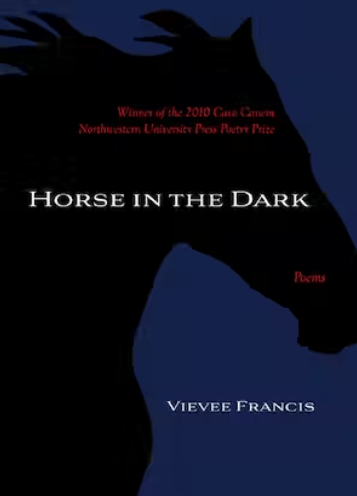
The Oxford English Dictionary (OED) includes two basic definitions of “nature.” The first definition is “the physical world collectively, including plants, animals, the landscape, and other features and products of the earth, as opposed to humans or human creations,” and the second is “the basic or inherent features, character, or qualities of something.” Francis’ “The Scale of Empire” works with both definitions, though argues with the first. Of course, this essay has defined the first term of “nature” with the many images of plants, animals and insects in “The Scale of Empire.” It is clear, however, that this poem does not portray nature as separate from humans, but as a physically inescapable being. The slave corpses, when they become this hybrid with nature—nature feeding bodies as bodies feed nature—seem to then take on a power of their own, a power so strong they can slowly bend the rigid structures placed before them. It is in this way the poem also works with the second definition of “nature.” In a sense, the poem is about the nature (second definition) of nature (first definition). In Francis’ second collection, Horse in the Dark, the speaker becomes much more personal when exploring nature, focusing more on the second definition.
In “De Rerum Natura,” Francis’ poem alludes to a work titled the same by Titus Lucretius Carus, or simply “Lucretius.” Translated into English as “On the Nature of Things” and written nearly 100 BCE, Lucretius’ six-book poem explores the nature of the world, preluding many scientific findings—specifically ideas closely resembling the concepts of atoms and natural selection—hundreds of years before such theories were explored. The work argued against the idea of a conscious afterlife and the traditional view that deities control everything, instead asserting that many natural phenomena happen by chance. In relation to Francis’ work, however, what perhaps is more important to note is Lucretius’ view that not all combinations of elements are possible, as shown in his example of centaurs. Because humans and horses have different life cycles and age at different rates, Lucretius argues they could not have possibly existed. Francis’ poem seems to refute the argument that two different beings cannot combine to create a hybrid, and she does so in referencing Hylonome in Ovid’s Metamorphoses.
Jeri Blair DeBrohun, in “Centaurs in Love and War: Cyllarus and Hylonome in Ovid’s Metamorphoses,” explores the centaurs Cyllarus and Hylome and their characteristics, specifically showing how the existence of such creatures in Metamorphoses was a way for Ovid to rebut Lucretius:
“Ovid not only includes in his epic certain of the myths that Lucretius inveighed against but also pointedly, and often humorously, exploits Lucretius’ scientific-didactic language for his own purposes as he remythologizes the characters and stories that the earlier poet had attempted to prove invalid. In this instance, Ovid challenges Lucretius’ scientific refutation of the possibility that Centaurs existed.”
The article shows examples of Lucretius’ viewpoints toward centaurs—the poor mixing of a human and horse—paralleling these with Ovid’s descriptions of Cyllarus, a centaur with nearly perfect proportions of human and horse. DeBrohun then continues to compare Cyllarus, the male centaur, to Hylonome, the female, a rarer creature as not many female centaurs are mentioned in Greco-Roman mythology. Lucretius also does not mention them in his work, which may have led to Francis’ poem.
The epigraph of Francis’ “De Rerum Natura” alludes to Philostratus the Elder who is known for his writings, Imagines, where he states, “How beautiful the Centaurides are, even where they are horses; for some grow out of white mares….” The rare female “centaurs” and rare “white mares” contrast with part “i” of the poem, as the speaker contemplates her own common horse, Trixie: “I named my horse Trixie / and was half-afraid to ride her / brown as me and equally skittish….” Here, the poem acknowledges a relation between the speaker and the horse, in color as well as character: “but once upon her, we were joined / at the withers. I was no less / than Hylonome.” Apart, the two were common, but together they were a rare creature: the centauride. Also, becoming Hylonome is not only a refutation of Lucretius’ De Rerum Natura but a description of the speaker. Going back to DeBrohun’s article, Hylonome in comparison to Cyllarus is seen as wild: “each element of her description is related to her life as a creature of the woods, as she decorates her hair with wildflowers, bathes in forest waters, and dresses herself in the skins of wild beasts.” This wildness proves a positive quality in “The Scale of Empire” as well as seen in Cole’s epigraph, “Yet the most distinctive, and perhaps the most impressive characteristic of American scenery is its wildness.” Here, Hylonome’s wildness not only meshes perfectly with Cyllarus’ contained nature but makes her stronger in battle. It is Cyllarus who dies first, which in turn causes Hylonome to kill herself.
In part “ii,” the poem directly references De Rerum Natura: “According to Lucretius, Each man struggles to escape himself….” This quoted passage continues the argument in part “i” since the speaker does not struggle to escape herself; she is able to do so every day when riding Trixie and becoming Hylonome. However, another meaning is suggested. There is a simultaneous undertone of sadness and communion that “each man” has similar struggles through life. This leads to the next line, “though a horse is discussed in better terms / than a mule.” Here, the speaker relates herself to a mule and is not so naïve as to think the mule is seen as equal to the horse. “From what does the mule run? / the ass of her mother? the stomping rage / of her father?” Mules are off-springs of a female horse and male donkey. The “ass” of the mother can be seen as the derriere of the mother, or—more likely—as a reference to the father who is an “ass” literally, since he is a donkey, but also figuratively as he has a “stomping rage” common in many jack donkeys.
In part “iii,” a devastating twist takes place, “Lamentation: Trixie died,” the statement mimicking death in its sudden finiteness. The simple declarative sentence continues: “I don’t remember how. I remember / her girth, the comfort of knowing / all that she was was mine.” In this death, a part of the speaker’s identity has passed on. Similar to Cyllarus’ death, Trixie’s death in turn kills Hylonome, as there can no longer be a centauride without the horse counterpart. This is further shown through the line break in “I / remember,” leaving the lonely “I” dangling at the end of the line.
Shifting a bit in allusions, in part “iv” the mule metaphor further unravels from part “ii:” “Zora’s claim: De nigger woman is de mule…” This references Zora Neale Hurston’s Their Eyes Were Watching God, a story of a mixed-race girl struggling to survive in a world ruled by men in both black and white societies:
“Honey, de white man is de ruler of everything as fur as Ah been able tuh find out. Maybe it’s some place way off in de ocean where de black man is in power, but we don’t know nothin’ but what we see. So de white man throw down de load and tell de nigger man tuh pick it up. He pick it up because he have to, but he don’t tote it. He hand it to his womenfolks. De nigger woman is de mule uh de world so fur as Ah can see” (Hurston 44).
This is the nature of the world: “Each man struggles,” as Lucretius states, but some struggle more as can be seen in Hurston’s passage. The white man is above the black man, but the black man is still above the black woman. The second and third lines of part “iv” continue: “capable of speech, / meaning: a beast no more or less.” This hits at the heart of the poem; there is not much explanation needed. Society views the black woman as a beast.
A beast, however, as shown through the reference to Hylonome, does not have to be a negative term. Part “v” harkens back to the horse, Trixie: “Like any child, of course, I loved horses / more than myself, and believed Trixie / spoke to me in a language all our own.” The speaker had strength when connecting to Hylonome, who wore the “skins of wild beasts.” Though there is sadness in Trixie’s loss (she loved the horse more than herself, similar to Hylonome and Cyllarus’ relationship), there is power in finding the connection between two different beings—a “language all our own”—which Lucretius thought impossible.
Therefore, after reading part “v” and taking into account the possible reimagining of what it means to be part “beast,” part “vi” has a different tone than if read on its own: “I saw Francis on television, I said, Ma, / I’m a mule, we’re mules, quick, come see.” There is a slight play on words here as the poet’s last name is Francis. The work being referenced is a 1950s comedy series about a talking mule in the U.S. army. Though this can be seen as a sad reference—that at such a young age the speaker felt herself to be a mule and the butt of jokes in mass media—when positioned after part “v” there is strength in this viewpoint. The speaker enjoyed being part beast as a child, and Francis shows the television mule as a wise soldier compared to his inept human counterpart.
Parts “v” and “vi” further strengthen the last section, part “vii,” when the poem returns to the initial allusion: “Impossibility: / the verdict of Lucretius, / who could not have imagined me.” This is a direct blow to Lucretius. Two beings could be joined and live in harmony, as exemplified when the speaker would become like Hylonome with Trixie. In other words, the speaker could live as a half-human half-beast as society has portrayed the black woman, and not only would she be half-beast but would be stronger because of it. Lucretius could not have imagined that.
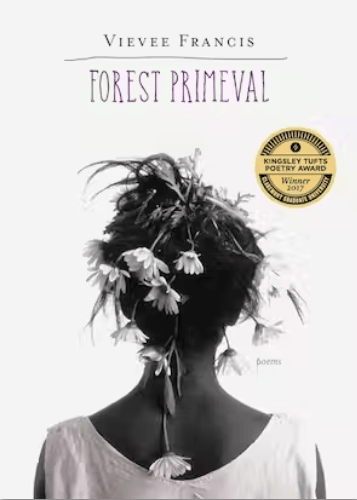
This opening up leads to Francis’ most recent collection, Forest Primeval, a brave exploration of the past and an acceptance of the self. Mirroring “The Scale of Empire” in her first collection, Forest Primeval’s first poem “Another Antipastoral” explores nature up close, but this time inserting the authoritative “I” more directly into the poem: “I want to put down what the mountain has awakened.” Immediately, the “I” takes agency, and the huge image of a “mountain” brings a large scale, similar to Cole’s paintings, to this piece. The quiet, compound verb “put down,” instead of “throw down” or something more forceful, shows reverence, especially when coupled with “awakened.” The mountain is the poet’s muse and inspiration; like the corpses in “The Scale of Empire,” the poet feeds off its stories.
In the first two images, the poem shows what the mountain has awakened: “My mouthful of grass. / My curious tale.” Notice the play on “tale,” which could double as “tail.” There is a sense of origin here; grass symbolizes roots, possibly familial or historical, or possibly relating to the slave corpses. A mouthful of grass, like the speaker’s “tale,” shows how familial or historical roots have prevented her from communicating, or more largely, how historical events have prevented African Americans from sharing their stories. The next sentence, “I want to stand still but find myself moved patch by patch,” plays on the agency of the poem. The “I” no longer has control but finds herself “moved,” though it is unclear what moves her. When moved, she goes from grass patch to grass patch, which, if continuing the metaphor of grass representing family or history, would represent memories or stories from the past.
In the next sentence, the poem enters the body of an animal, presumably a goat, similar to the mule in “De Rerum Natura:” “There’s a bleat in my throat. Words fail me. Can you understand?” Here, words “fail” because others cannot understand the “half-beast” perspective. The next sentence again shows the lack of agency: “I sink to my knees tired or not.” This is a posture of succumbing. The “I” cannot communicate, so she sinks, literally, to nature in both senses of the definition: the nature of how the world responds to her and the physical nature that surrounds her. “I now know the ragweed from the goldenrod, and the / blinding / beauty of green.” Here, the speaker not only understands more fully the physical aspects of nature, but she understands better the nature of the world. Juxtaposing plants like “ragweed,” which in its name sounds poor and ugly, and “goldenrod,” a flower which, in its name, sounds rich and beautiful, and stating she understands the difference between the two brings to light what the speaker now knows about the separation of classes: “the / blinding / beauty of green.” Putting emphasis and sectioning off “blinding” de-emphasizes the word “beauty.” The poem focuses on the fact that beauty—or what is beautiful in society’s eyes—is blinding. “Don’t you see? I am shedding my skins.” This shedding of skins leads into a list of all that “I” is: “I am a paper hive, / a wolf spider, / the creeping ivy, the ache of a birch, a heifer, a doe.” She is fragile like a paper hive, and fierce like a wolf spider. The “creeping ivy” relates directly back to “The Scale of Empire” and nature’s persistent strength. The “birch” at first brings to mind the simple sway of birch trees in wind but coupled with the word “ache” brings to mind the action of “birching,” a common punishment in the United Kingdom until the mid-twentieth century, and a punishment which may have been used on slaves in the American South. This violent image, then followed by the soft “heifer,” a female cow who has not yet given birth, and “doe,” emphasizes gender, suffering, and more clearly how the “I” views herself.
In the following sentence, the poem shifts slightly in mood: “I have fallen from my dream of progress: the clear-cut glass, the potted and balconied tree, the lemon-waxed wood over a marbled pillar, into my own nocturne.” Notice the reference of a “marbled pillar” harkening back to “The Scale of Empire” and the inevitable crumbling of man-made structures. With the mentioning of “nocturne,” it is helpful to refer to Edward Hirsch in A Poet’s Glossary where “nocturne” relates to a time of night when a deeper contemplation takes place which cannot happen during the day, when “everything must be let go that is associated with day or daylight mind” (413). As Hirsch quotes Susan Stewart: “‘The night is often the secret site of initiation, purification, and other threshold activities bridging the relation between what is human and what is not human and providing context for changed roles and states of being’” (412). Here, the speaker has fallen from her safe and controlled life of “clear-cut” glass, trees which are contained in pots on balconies, wood coated in wax to prevent slivers—a life that has attempted to erase the past and how past generations and her ancestors were treated—and is now in an opposite state of mind, a more fluid state where she is not separate from the inhuman, or the “beast.”
The next sentence continues its “nocturne” sense: “The lullabies I had forgotten. How could I know what slept inside?” Hirsch states, “the modern poetic nocturne…is frequently a threshold poem that puts us in the presence of nothingness or God—it returns us to origins—and stirs poets toward song.” As mentioned, the poem has been working with origins—mountains and grass—since the first few lines. The mentioning of “lullabies” recalls childhood which also implies beginnings and how these origins were forgotten. The strangeness of the statement “How could I know what slept inside?” brings a discomforting menace to the poem: a secret of what has been hidden from the speaker—possibly a past familial experience? The “I” has experienced something dark but knows she should not feel guilt: “how could she know?”
The last sentence continues the strange, secretive mood: “What would rend my fantasies to cud and up from this belly’s wet straw-strewn field– / these soundings.” “Cud” alludes to cows, again recalling the speaker’s relation to a beast. The action “to cud and up from this belly” shows the process of opening and exposing oneself both sonically and physically, “cud” being nearly onomatopoeic with a cough and “up from this belly” a visceral image of vomiting. The last line, “these soundings,” is vague, and the phrase’s position on the page as it off-hangs the em dash on the previous line brings a teetering quality; the poem has “fallen” into “these soundings” just as it has fallen into a song between the human and inhuman: a nocturne state which sings for the rest of the collection.
By the final poem of Forest Primeval, “Chimera,” the “I” exposes herself fully. Directly referencing the part lion, part goat, part serpent, fire-breathing female beast, the poem shows the “I” not only accepts herself but is not afraid to be fierce. The epigraph from poet Jamaal May, “She’s not ‘maternal,’ she’s dangerous,” leads straight into the poem. Unlike other poems mentioned, this one starts each line with capitalization, giving each its unique, individual importance. The first line begins: “I have no charms. Admittedly.” The curt statements ask for no questions, and the poem is clear now, revealing who the “I” is: “No gold comb can move through / This mane.” Notice the reference to socioeconomic class with “gold comb” working in a similar way to “goldenrod” in “Another Antipastoral.” The poem relates the speaker’s hair to a “mane,” exposing the wildness first felt in the reference to Hylonome in “De Rerum Natura” but only fully discovered here. “My skin is not translucent.” Again referencing “Another Antipastoral,” she knows how many layers of “skin” she has, alluding to past experiences: trauma, racism, sexism. The skin is not “translucent,” which implies thin and white; it is thick and black, playing on the saying that someone who is strong has “thick skin.” “Mine is a tail to fear. I know.” “Tail” is a play on the word “tail/tale,” as the tale mentioned in “Another Antipastoral” has thus far been a fear-inducing subject. “Tail” can also be another reference to the chimera with a serpent tail, and again an image of ferocity. “I know” suggests the “I” has knowledge of the serpent, possibly alluding to the story of Adam and Eve and the experience of womanhood and feeling “damned.”
The next sentence stretches longer than the first few: “And though a mother may destroy, / She too sees fit to create beauty / That would eventually grow into forms / I would swallow if I gave in / To my hungers.” Here, the poem references both “Another Antipastoral” and “The Scale of Empire.” When mentioning “mother,” it is unclear whether the poem refers to the speaker’s mother or Mother Nature. There is a sense in the use of the article “a” that it could be any mother, and that often these mothers destroy their children, though unknowingly, as “She too sees fit to create beauty….” This could be a reference to miscarriages or other similar trauma. Here, beauty is referenced like in the first poem of the collection and, again, it is not necessarily a positive term. The mother destroys in her attempt to “create beauty,” which, as mentioned in “Another Antipastoral,” is “blinding.” The mother does not realize this beauty “would eventually grow into forms” the “I” wants to consume. This concept of consuming harkens back to “The Scale of Empire.” The speaker finds that similar to vines and insects, she feels the need to consume all that is “beautiful.” She tries not to give in to her hungers as the plants and animals have in “The Scale of Empire,” but the poem intimates a close-to-breaking point—a need to revert to a natural state. The next sentence states: “Nothing will come / Of this womb.” This is direct: the “I” knows she will never have children and therefore never be a mother, which when referring back to the lines that mothers “destroy,” seems intentional. However, the next sentence continues: “But up from my wounds–,” suggests that this may be a painful concept—a wound—for the speaker.
This is where the “I” also finds strength, however, as the next lines state, “From this goat’s body– / Up from my wood-smoke lungs, from / The milk of me, comes a song, a melody / To open yours, then lick them clean.” The beginning images of the “goat’s body” recall, of course, the chimera; however, they also reference the “bleat” from the speaker in “Another Antipastoral.” The speaker has always been a “half-beast,” whether a centauride or chimera. The image of unused milk brings to mind the missed chance at motherhood, which in turn is a source of sustenance—like the corpses that feed nature—to carry on the “song” and expose others to help them “open” and “lick them [their wounds, traumatic events or stories] clean.”
Vievee Francis’ work thus far has shown itself to be a slow unraveling and acceptance of the self. As shown in Horse in the Dark and Forest Primeval, Francis rejects the way her aesthetic is viewed, a tactic she speaks of in an interview with Nomi Stone for the Los Angeles Review of Books: “I reject the way my aesthetic is viewed. The book [Forest Primeval] is very much telling others to reject these conventional boxes.” The black woman’s aesthetic has equivalented with “beast” throughout history. Instead of rejecting the aesthetic, Francis rejects the way it is viewed, showing how beastly beings—centaurides and chimeras—can have their own beauty, strength, and pride. The speaker in each of her poems explores “nature,” whether it be in the first or second OEM definition of the word. In Blue-Tail Fly’s “The Scale of Empire” the “I” is nearly absent; only a few images hint at setting to imply a sense of the speaker’s identity. This poem explores both definitions of nature to show the persistent strength in nature, relating to the fortitude present in the black population, as well. Horse in the Dark’s “De Rerum Natura” alludes to numerous works—namely Titus Lucretius Carus’ De Rerum Natura and Ovid’s Metamorphoses—to explore the way the black woman is viewed as part “beast.” It is in this poem that the speaker’s own power comes to the surface as she begins to redefine what it is to be a hybrid creature. In Forest Primeval’s “Another Antipastoral” and “Chimera,” the “I” explores both physical nature and the nature of society, finally opening and exposing the speaker fully, hoping others in turn will “lick” their wounds clean as well and accept the powerful beast within.
Works Cited
Cole, Thomas. “The Course of Empire.” Explore Thomas Cole. http://www.explorethomascole.org/ tour/items/63. Web. 24 March 2019.
Debrohun, Jeri Blair. “Centaurs In Love and War: Cyllarus and Hylonome in Ovid’s Metamorphoses 12.393-428.” American Journal of Philology 125.3 (Fall 2004): 417-452. Web.
Francis. Dir. Arthur Lubin. Perf. Donald O’Connor, Patricia Medina, and Zasu Pitts. Universal Studios, 1950. Amazon Prime Video.
Francis, Vievee. Blue-Tail Fly. Detroit: Wayne State University Press, 2006. Print. 1-2.
Francis, Vievee. Forest Primeval. Evanston: Northwestern University Press, 2016. Print. 3 and 92.
Francis, Vievee. Horse in the Dark. Evanston: Northwestern University Press, 2012. Print. 31-32.
Francis, Vievee. Interview by Laura Steadwell. “Interview with Vievee Francis.” Muzzle Magazine. https://www.muzzlemagazine.com/vievee-francis-interview.html. Web. 24 March 2019.
Francis, Vievee. Interview by Nomi Stone. “This is My Name: A Conversation with Vievee Francis.” Los Angeles Review of Books. 14 Feb. 2018. https://lareviewofbooks.org/article/ this-is-my-name-a-conversation-with-vievee-francis/#. Web. 24 March 2019.
Hirsch, Edward. A Poet’s Glossary. New York: Houghton Mifflin Harcourt, 2014. Print. 412-413.
Hurston, Zora Neale. Their Eyes Were Watching God. Philadelpia: J. B. Lippincott, 1937. Print. 44.
“Nature.” Oxford English Dictionary. https://en.oxforddictionaries.com/definition/nature. Web. 24 March 2019.
Philostratus the Elder. Imagines. Trans. Arthur Fairbanks. Loeb Classics Series. Cambridge: Harvard University Press, 1931. https://www.theoi.com/Text/PhilostratusElder1A.html. Web. 24 March 2019.
Sedley, David. “Lucretius.” The Stanford Encyclopedia of Philosophy. Winter 2018 ed. https://plato.stanford.edu/archives/win2018/entries/lucretius/. Web. 24 March 2019.

 elbristow.com